
Historic Brick Restoration in Richmond, VA
Richmond's older brick homes were built to last for generations, but only if they're cared for the right way. Heritage Masonry & Brick restores historic brick and masonry across Richmond, VA, especially in the Fan, the Museum District, Church Hill and the city's other older neighborhoods. We repair, repoint, clean and restore brick the old way, in lime mortar and matched brick, so it's protected for decades and still looks like itself.
We're a family of traditional masonry contractors. Brick is all we know. Restoring an old Richmond house means working the way it was built: saving original brick, carefully cutting out hard cement, repointing in lime mortar and letting it cure properly. Our family roots go back to Scotland, where building in stone and brick with lime mortar has centuries of tradition.
We're a family of traditional masonry contractors with over 25 years of experience, and older brick homes are the work we know best. We're licensed and insured in Virginia, and every restoration comes with a 5-year guarantee on labor and materials.
Historic Brickwork
Restoration of older brick homes and buildings, including brick repair, repointing and tuckpointing, and chimney repair.
Matched Brick & Mortar
We match existing brick and mortar, including lime mortar on older brickwork, so repairs blend in with the original.
Why Heritage Masonry & Brick
Licensed and insured in Virginia, with a 5-year guarantee on labor and materials and free estimates. Open 7 days, 8am–6pm.

2026 Quality Business Award
The Best Masonry in Richmond, Virginia
Winner of the 2026 Quality Business Award for The Best Masonry in Richmond, Virginia, recognizing an overall quality rating of 95% or higher. Heritage Masonry & Brick is also listed on the Virginia DHR Historic Trades List.

Masonry Restoration Guide
Our Masonry Restoration Services
- Historic brick repair. Repairing the brick on older homes with materials and methods that suit the original.
- Brick repointing and tuckpointing. Cutting out worn or failed mortar and replacing it with a lime mix traditional mortar matched to the original.
- Brick repair and replacement. Replacing cracked, loose and spalled brick with brick matched in color, size and texture.
- Mortar and brick color matching. Matching new mortar and replacement bricks to the old ones, so repairs disappear into the wall.
- Painted brick restoration. Taking failed or unwanted paint off older brick to bring back the original brick.
- Brick cleaning. Removing dirt, green growth and staining from walls, steps and stoops.
- Removing old cement repairs. Taking out hard cement patches and joints that are damaging softer old brick, and redoing them in lime mortar.
- Chimney restoration. Repointing and rebuilding historic chimneys. See our Chimney Repairs page for more.
- Steps, stoops and garden walls. Restoring the original brick steps, stoops and front walls found on so many older Richmond homes.
- Stone and stucco. Repair and restoration of stone and stucco on older buildings.
- Commercial and mixed-use buildings. Restoration on older commercial brick buildings.
How Older Brick Works and Why It Needs a Different Approach
Many homes built in Richmond before the early 1900s were laid with soft brick and lime mortar. That combination works differently from modern masonry, and knowing why is the key to restoring it properly. We do a lot of historic brick work in the Fan and Museum District.
Lime mortar is softer and more breathable than the brick around it. It lets moisture that gets into the wall dry back out, and it flexes slightly as the building moves with the seasons. Over many years, the mortar slowly wears away instead of the brick. Repointing is the normal maintenance that keeps the system working.
Problems start when this is ignored, or when older brick is repaired with modern materials:
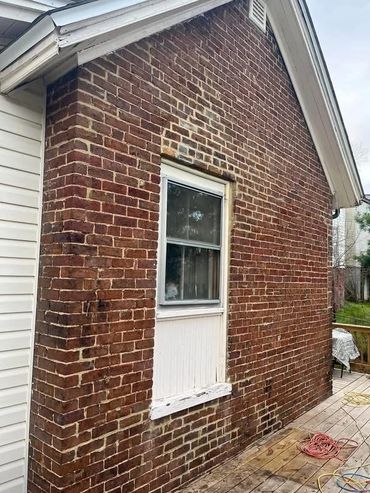
- Hard cement mortar. Portland cement mortar is harder and less breathable than old brick. Moisture gets trapped and has to leave through the brick instead, and freeze-thaw cycles then break down the brick face. That's why you'll often see old brick crumbling right next to a grey cement patch.
- Spalling. The face of the brick flakes, pops or crumbles off. Spalling usually means moisture is trapped in the brick, often from hard mortar, paint or a leak.
- Efflorescence. White, powdery salt deposits on the brick. They show water is moving through the wall, which is worth tracking down.
- Paint on brick. Paint can seal in moisture, and when it starts to peel it can trap water against the brick.
- Freeze-thaw damage. Water that gets into open joints or soft brick freezes and expands, a little more each winter.
- Green staining and growth. Shady steps and walls can stay damp, and moss and algae grow on them, which keeps the brick wet.
Restoring Historic Brick the Way It Was Built: in Lime
Richmond's older brick was fired softer than today's and laid in lime mortar, and the two were meant to work as one. The lime joint is softer and more breathable than the brick. Water dries out through the joints, salts come out in the joints, and over the years the joints wear back while the brick stays sound. Repointing every few generations is how the system was meant to be looked after.
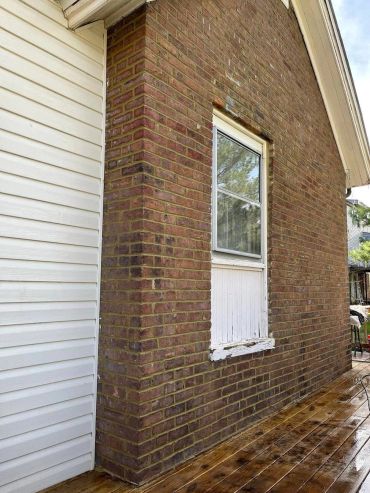
A good restoration keeps that system working. We match the new mortar to the old in color, sand, texture and joint profile, and we choose the lime to suit the wall: lime putty for the softest brick and sheltered walls, natural hydraulic lime (NHL) for chimneys, parapets and other exposed work. Where earlier repairs used hard Portland cement, we take it out only as far as we can without hurting the brick, then repoint in lime. A small sample panel goes up first on street-facing walls so you can see the match before we do the house. Then each section is kept damp and shaded while it cures, slow and proper.
Brick Repair on Older Homes
Historic brick repair is about saving as much original brick as possible. Bricks that are only worn or stained are usually left in place. Bricks that are cracked through, spalled deep into the face or loose are cut out one by one and replaced. A replacement brick has to match the old one in size, color and texture, and it has to be laid in a mortar that's softer than both, so it doesn't harm the bricks around it. Where a whole section has failed, such as a parapet, a corner or the top of a garden wall, we take it down and rebuild it, reusing the sound original brick wherever we can. Our Brick Repairs page has more on general brick repair.
Brick Repointing vs. Tuckpointing
People often use the words "repointing," "tuckpointing" and "tuck pointing" for the same job, and on most homes that's fine. Strictly speaking, they're different:
- Repointing means cutting out worn mortar to a sound depth and refilling the joints with fresh mortar. It's the core maintenance job for any older brick wall.
- Tuckpointing is a finishing technique. The joints are filled with mortar colored to match the brick, then a thin, neat line of contrasting mortar is "tucked" into the center, so the brickwork looks finer and more even than it really is. You'll find it on some older Richmond homes, and it should be recreated when those joints are repointed.
Whichever it is, the same rules apply on old brick. Remove the failed mortar cleanly without chipping the edges of the brick, use a lime mortar that's softer than the brick, and match the original joint width and finish. We remove mortar with diamond-tip grinding blades for a clean, controlled cut. See our lime mortar repointing page for more.
Mortar and Brick Color Matching
A repair only looks right if you can't see it. That depends on matching both the mortar and the brick.
- Mortar color. Old mortar gets its color mostly from its sand, lime and age. We look at the original joints, including inside a fresh break where the color hasn't weathered, and mix a lime mortar to match its color and texture. Joint style matters too: flush, struck, concave or tuckpointed joints each look different.
- Brick color and size. Old Richmond brick varies from brick to brick and has softened with age, so new brick rarely matches straight off the pallet. We match replacement bricks for color, size and texture as closely as we can, and on larger repairs we reuse sound original brick wherever possible.
The result is a repair that blends in with the original wall instead of standing out as a patch.
Our Restoration Process, Step by Step
- Assessment. We look closely at the brick, the mortar, any paint or past repairs, and where water is getting in. We explain what we've found and what we'd recommend, and give you a free written estimate.
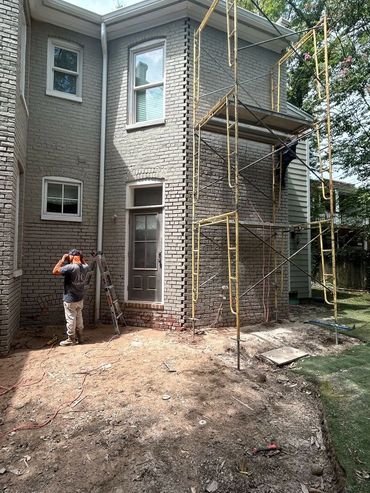
- Protecting your property. We protect windows, doors, plants, walkways and nearby surfaces before work starts.
- Mortar and brick color matching. We match new mortar and replacement bricks to your home's original brick, mortar color, texture and joint style as closely as possible.
- Removing failed mortar and old patches. We cut out worn mortar and hard cement repairs with diamond-tip grinding blades, which give a clean, controlled cut. Care is taken to keep the edges of the old brick intact.
- Repairing and replacing brick. We take out damaged and spalled brick and set matched brick in its place.
- Repointing and tuckpointing with lime mortar. We fill the joints with a lime mix traditional mortar suited to older brick and tool them to match the original joints, including tuckpointed finishes where the house has them.
- Cleaning and paint removal. Where needed, we clean the brickwork and remove paint to bring back the original brick.
- Final check and clean-up. We check the finished work and leave your property clean and tidy.
Why It Matters in the Fan and Richmond's Historic Neighborhoods
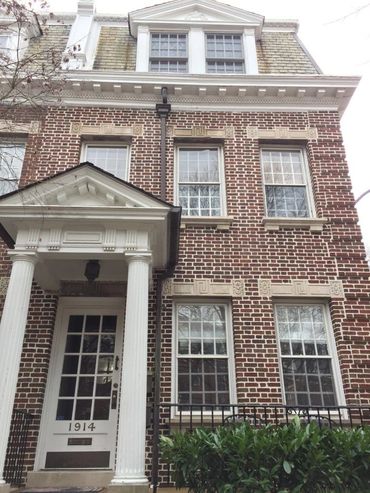
Richmond is known for its historic brick neighborhoods. The Fan, the Museum District, Church Hill, Jackson Ward, Oregon Hill, Monument Ave, Shockoe Bottom and Manchester are known for their rows of brick homes, cornices and front stoops. Windsor Farms, Bellevue, Ginter Park, Westover Hills, Forest Hill and Northside have their own older brick homes too.
In these neighborhoods, restoration isn't only about fixing a problem. It's about keeping the look and value of a historic home and street. Done well, repairs blend in and the original brick keeps doing its job. Done badly, with hard mortar or mismatched brick, they can stand out for years and damage the house they were meant to protect.
Parts of Richmond are designated City Old and Historic Districts, and exterior changes there, such as paint removal or rebuilding, can need approval. If your home is in one, check with the City of Richmond before visible work begins.
Areas We Serve
We restore historic brick and masonry throughout Richmond, VA, including the Fan, Museum District, Church Hill, Jackson Ward, Oregon Hill, Monument Ave, Windsor Farms, Bellevue, Ginter Park, Shockoe Bottom, Manchester, Scott's Addition, Carytown, Westover Hills, Forest Hill and Northside. We also serve Henrico, Chesterfield, Hanover, Goochland and Powhatan.
Why Heritage Masonry & Brick
- Winner of the 2026 Quality Business Award for The Best Masonry in Richmond, Virginia
- A family of traditional masons
- Over 25 years of experience
- Licensed and insured in Virginia
- 5-year guarantee on labor and materials
- Historic brick repair, repointing and tuckpointing
- Mortar and brick color matching
- Lime mix traditional mortar suited to older brick
- Diamond-tip blades for clean, controlled mortar removal
- We leave your property clean and tidy
- Open 7 days a week, 8am to 6pm
Frequently Asked Questions
Why shouldn't old brick be repointed with modern cement mortar?
Modern cement mortar is harder and less breathable than historic brick. It traps moisture and forces it out through the brick instead, which leads to spalling and cracking. Lime mortar is softer than the brick, so the mortar wears instead of the brick, and it can be renewed again in the future.
What's the difference between repointing and tuckpointing?
Repointing means replacing worn mortar in the joints. Tuckpointing, also written "tuck pointing," is a finishing style: brick-colored mortar with a thin contrasting line set into the joint. Many people use the words to mean the same thing. We do both, and match whatever your house has.
Can you match my home's original brick and mortar?
Yes. We match the color, texture and size of the brick, and the color and joint style of the mortar, as closely as possible, so repairs blend in with the original.
Can paint be removed from old brick?
In many cases, yes. Paint removal can bring back the original brick and let the wall breathe again. Results depend on the brick and the type of paint, so we look at your wall first and talk you through what to expect.
What causes the white staining on my brick?
That's efflorescence: salts carried to the surface as water moves through the brick. It isn't harmful in itself, but it shows where water is getting in. We find the source and fix it as part of the restoration.
How often does an old brick house need repointing?
Lime mortar is designed to wear slowly, and well-done repointing lasts many years. Exposed areas such as chimneys, parapets, steps and garden walls usually need attention before sheltered walls do. Open, crumbling or recessed joints are the sign it's time.
Do I need approval to restore brick in a historic district?
It depends on where your home is and what's being done. Parts of Richmond are City Old and Historic Districts, where exterior work can need approval. Check with the City of Richmond before visible work starts.
Old houses were built to last for generations. Restored the same way, they will again. If you want the job done right the first time, look no further. We'd rather do it once, the old way, than come back in a few years to fix somebody's shortcut. The National Park Service's guidance on repointing historic masonry (Preservation Brief 2) says a well-done repointing job should last at least 30 years, and preferably 50 to 100. Historic England warns that hard, cement-rich mortar on old brick traps moisture and speeds up the decay of the brick around it. So we choose the lime mortar to suit the wall, fill the joints properly and let them cure slowly. Work built to last decades.
Call for a Free Restoration Estimate
If your older brick home needs repointing, brick repair, paint removal or a full restoration, call Heritage Masonry & Brick at (804) 324-6304. We're open 7 days a week, 8am to 6pm, and every job comes with a 5-year guarantee on labor and materials.
Heritage Masonry & Brick
600 E Cary St, Richmond, VA 23219
(804) 324-6304
Get Your Free Masonry Restoration Estimate
Visit or Call Us
Our office is at 600 E Cary St, Richmond. We're open 7 days, 8am to 6pm.
Hours
Open today | 08:00 am – 06:00 pm |
Copyright © 2026 Heritage Masonry & Brick - All Rights Reserved.
Heritage Masonry & Brick · 600 E Cary St, Richmond, VA 23219 · (804) 324-6304
(804) 324-6304
By contacting us via SMS with your mobile number, you consent to receive customer care text messages from Heritage Masonry & Brick. Msg&Data rates may apply. Message frequency varies. Text HELP for help. Reply "STOP" at any time to opt out.
Heritage Masonry & Brick © 2026