Masonry Advice for Richmond Homeowners
Brick is one of the most durable building materials there is, but it lasts longest when it's looked after the right way. After more than 25 years as a family of traditional masons, we've seen what keeps Richmond brick homes in good shape and what does the most harm. Here's the advice we give homeowners most often on brick repair, brick repointing and tuckpointing, lime mortar, mortar color matching, chimney repair and brick steps.
2026 Quality Business Award
The Best Masonry in Richmond, Virginia
Winner of the 2026 Quality Business Award for The Best Masonry in Richmond, Virginia. The award certificate recognizes an overall quality rating of 95% or higher. Heritage Masonry & Brick is also listed on the Virginia Department of Historic Resources (DHR) Historic Trades List, the state's directory of tradespeople who work on historic buildings.

Brick Care Guide
Advice for Richmond Brick Homes
A yearly brick check you can do yourself
Walk around your house once a year, ideally in spring after the freeze-thaw season, and look for:
- Mortar joints that are recessed, crumbly or missing, especially low on the walls and under windowsills
- Brick faces that are flaking or popping off
- White powder (efflorescence) or dark damp patches, which show where water is getting in
- Cracks above windows and doors, at corners, or in a stair-step pattern
- Your chimney from the street: look for leaning, missing mortar near the top, and a cracked crown
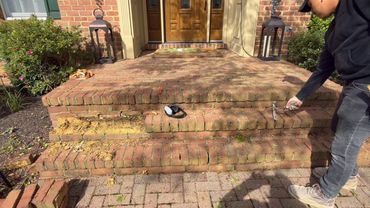
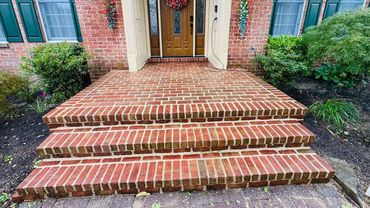
- Steps and stoops with loose treads, gaps against the house, or cracks around railing posts
Take photos. If something looks worse next year, that tells you it's moving or getting wetter.
We're a family of traditional masonry contractors. Brick is all we know. This is the same plain advice we'd give a neighbor: keep water off old brick, don't let anyone near it with hard cement, and when it's time to repoint, do it once, in lime, and do it right. Our family roots go back to Scotland, where building in stone and brick with lime mortar has centuries of tradition.
Keep water off and away from the brick
Most brick problems start with water. Before spending money on masonry, check the basics:
- Clean gutters and fix leaking seams
- Make sure downspouts empty well away from the foundation
- Grade soil and mulch so it slopes away from the house and doesn't sit against the brick
- Trim ivy and shrubs back from the walls so they can dry
Mortar: softer is often better on older brick
If your house was built before about 1940, as most homes in the Fan, Museum District, Church Hill and Jackson Ward were, it was most likely laid in lime-based mortar. That mortar is meant to be softer than the brick. WheWhen older walls are repointed with hard Portland cement mortar, the brick can start to crack and spall within a few winters, because the water that used to dry out through the joints now has to go through the brick. anyone repoints your house, ask what mortar they'll use and why. Our repointing and tuckpointing page explains this in more detail.
Lime Mortar vs Cement on Old Brick: What the Experts Say
You don't have to take our word for it. The National Park Service's guidance on repointing historic masonry, Preservation Brief 2, says new mortar should be softer and more vapor-permeable than the brick and should match the old mortar in color, texture and tooling. It also says a good repointing job is meant to last at least 30 years, and preferably 50 to 100.
Historic England's guide to repointing brick and stone walls gives the reason. Mortar should be slightly weaker and more permeable than the brick. Cement-based mortar stops moisture drying out through the joints, so it goes through the brick instead and speeds up the decay. Northern Ireland's Department for Communities notes that hard cement "strap" pointing, smeared over the joint, usually falls off after 10 to 15 years and can take the brick faces with it.
Lime itself comes as lime putty, which hardens slowly in air, or natural hydraulic lime (NHL), which also sets with water and suits wetter spots. Either way it has to cure slowly, kept damp and out of frost and hot sun. Ask any mason which they'll use, and why.Be c
areful with sealers and coatings
Clear water-repellent sealers are often sold as protection for brick. On older soft brick, many of them trap moisture inside the wall, which can lead to spalling. In most cases, fixing the water source and the mortar joints does more good than a coating.
Thinking about painting or stripping brick?
Painting brick is hard to undo and can trap moisture if the wrong paint is used. If your brick is already painted and the paint is peeling, stripping it can bring back the original brick, but it has to be done gently. Sandblasting and high-pressure washing strip away the hard outer face of old brick and leave it exposed to the weather. A careful paint removal uses suitable strippers and low-pressure rinsing. See masonry restorations for how we approach this.
Cleaning brick safely
For most dirt and staining, start with the gentlest option: plain water, a soft brush and patience. Avoid muriatic acid and pressure washers on older brick unless you know exactly what you're doing, since both can damage brick and mortar.
Chimneys need more attention than you think
Chimneys are the most exposed brickwork on a house. Cracked crowns and failing flashing let water into the chimney and into the house. Have the masonry checked every few years, and get a chimney sweep to inspect the inside, especially before using an older fireplace. Our chimney repairs page covers the common problems.
Historic district rules
Parts of Richmond, including Monument Avenue and parts of Church Hill, are City Old and Historic Districts. In those districts, exterior changes may need approval from the city before work starts. If your home might be in one, check with the City of Richmond first. Like-for-like repairs are usually simpler than changes to materials or design.
Questions to ask any mason before you hire
Whoever you hire, these questions help you spot a careful mason:
- What mortar will you use on my house, and is it softer than my brick?
- How will you match the mortar color, sand texture and joint profile?
- Will you use a grinder on my joints, or rake them out by hand where the brick is soft?
- Can you do a small test area first so I can see the match?
- Are you licensed and insured in Virginia, and what guarantee do you give?
- Will I get a written estimate that spells out the work and materials?
When to call a mason
Call a professional if you see cracks that are widening, brick that has shifted, a leaning chimney, loose brick at height, or water coming through a wall inside. Small problems are much cheaper to fix early.
Masonry advice FAQ
How often does brick need repointing?
Good lime mortar can last many decades. Rather than following a schedule, repoint when joints are recessed or crumbling.
Is efflorescence a problem?
The white powder itself is mostly cosmetic, but it shows water moving through the wall. Find and fix the source.
Can I patch mortar myself?
Small, low patches are possible, but the wrong mortar can damage old brick. If in doubt, ask us fir
The cheapest repointing job is the one you only pay for once. If you want the job done right the first time, look no further. We'd rather do it once, the old way, than come back in a few years to fix somebody's shortcut. The National Park Service's guidance on repointing historic masonry (Preservation Brief 2) says a well-done repointing job should last at least 30 years, and preferably 50 to 100. Historic England warns that hard, cement-rich mortar on old brick traps moisture and speeds up the decay of the brick around it. So we choose the lime mortar to suit the wall, fill the joints properly and let them cure slowly. Work built to last decades.st.
Related services
- Repointing and tuckpointing
- Brick repair
- Chimney repairs
- Historic masonry restoration
- Structural repairs
- Historic brick repair in the Fan and Museum District
Request a free estimate
Not sure what your brickwork needs? Call Heritage Masonry & Brick at (804) 324-6304 or send us a message on our contact page to book a free, no-obligation estimate. We come out, look at the work, explain what's causing the problem and give you a written estimate. Open 7 days a week, 8am to 6pm. Licensed and insured in Virginia, with a 5-year guarantee on labor and materials.


Need Help With Your Brickwork?
Masonry Repairs & Restoration in Richmond, VA
If you’ve noticed cracked bricks, deteriorating mortar, water intrusion, damaged steps, or other masonry problems, Heritage Masonry & Brick can help. We provide professional brick repair, repointing, chimney repair, structural masonry repair, and restoration throughout Richmond, VA and surrounding areas.
Why Choose Heritage Masonry & Brick?
A family of traditional masons. We do it the old way and build it to last. Lime mortar on old brick, matched brick and joints, proper curing. That's how we protect, repair and restore it, and how the house keeps its character.
Contact Us
Request a Free Masonry Estimate
Need brick repair, repointing, chimney repair, step repair, or masonry restoration? Call Thomas and the family at (804) 324-6304 for a free estimate in Richmond and the surrounding counties.
Heritage Masonry & Brick
600 E Cary St, Richmond, VA 23219, United States
Hours
Mon | 08:00 am – 06:00 pm | |
Tue | 08:00 am – 06:00 pm | |
Wed | 08:00 am – 06:00 pm | |
Thu | 08:00 am – 06:00 pm | |
Fri | 08:00 am – 06:00 pm | |
Sat | 08:00 am – 06:00 pm | |
Sun | 08:00 am – 06:00 pm |
Copyright © 2026 Heritage Masonry & Brick - All Rights Reserved.
Heritage Masonry & Brick · 600 E Cary St, Richmond, VA 23219 · (804) 324-6304
(804) 324-6304
By contacting us via SMS with your mobile number, you consent to receive customer care text messages from Heritage Masonry & Brick. Msg&Data rates may apply. Message frequency varies. Text HELP for help. Reply "STOP" at any time to opt out.
Heritage Masonry & Brick © 2026